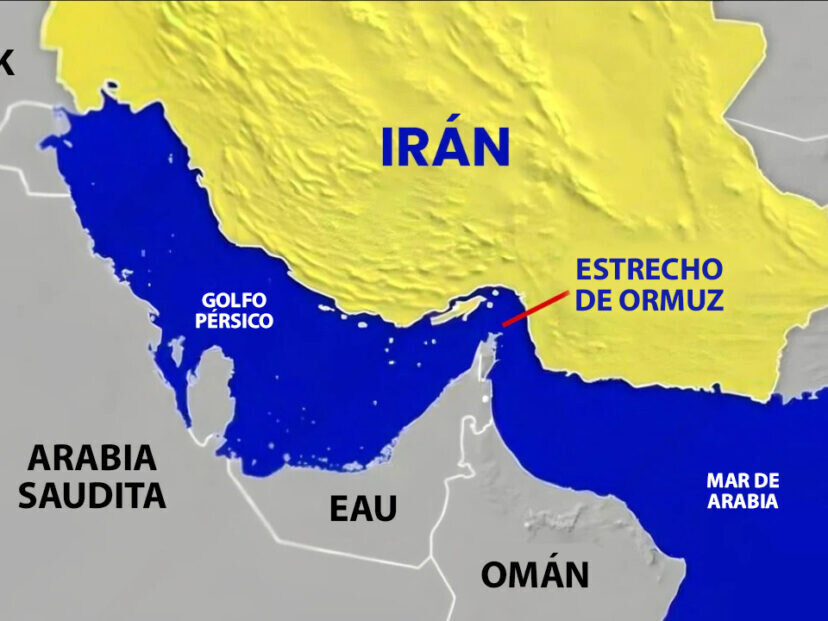
The risk is not only the loss of Iranian oil production, but also that an escalation involving the United States and Israel could affect critical maritime routes and exports from the entire Gulf region, recreating the typical conditions of an 'oil crisis': a jump in prices, supply problems, and macroeconomic effects that seep into inflation, activity, and logistics. History teaches us that these crises do not necessarily need a global absolute shortage to hit hard. That decision illustrates the essential: when the market smells a crisis, major producers move before a single barrel is missing. In parallel, uncertainty is not limited to oil: if geopolitical risk sets in, maritime insurance premiums rise, freight costs increase, routes are reorganized, and imported inflation accelerates. In that hypothesis, analyses cited by US media warn that prices could climb to the range of $130 per barrel, with an immediate pass-through to the price of gasoline in the United States and, by extension, to the rest of the world. Anxiety is already noticeable in energy policy: a Reuters dispatch on February 25 reported that Saudi Arabia is increasing production and exports as a contingency plan in the event of a US attack on Iran, seeking to cushion a potential shortfall and avoid a sharp price jump if the conflict interrupts flows. Closer in time, Russia's large-scale invasion of Ukraine in 2022 generated a price shock even without a full global physical shortage: fear, the reconfiguration of flows, and a sense of vulnerability were enough. Now the factor of instability is different, but the mechanism is similar: the market looks at the scenarios and begins to 'pay just in case.' And the dependence is total for several exporters: Iran, Kuwait, Iraq, and Qatar need the Strait of Hormuz as their outlet. On this board, a recent analysis by Le Grand Continent — based on scenarios from US study centers — describes four paths of escalation, all with the capacity to shake prices. There, the market would no longer speak only of 'risk,' but of barrels lost for months: in that case, it becomes plausible for Brent to stabilize above $100 if the escalation prolongs. The fourth scenario is the most severe: Iranian reprisals against oilfields, terminals, or maritime platforms of Arab Gulf countries. Sometimes war seems far away; the price of gasoline, not so much. The first would be a campaign focused on Iranian exports, with special attention to the island of Kharg, a key terminal: a blow there could remove about 1.6 million barrels per day from the market and push the price of crude up $10 to $12 per barrel, due to flow reallocation and an increase in insurance premiums. There, a significant portion of regional exports is threatened, and the shock could exceed the peaks of 2022, especially if Qatar's LNG exports are also interrupted. Although a total blockade is difficult to sustain, a partial and temporary interruption would be enough to cause a rapid rise in oil and transportation costs, with a direct impact on fuels and global logistics. The third scenario steps up a notch: US or Israeli attacks on Iranian oil facilities that cause lasting damage to production and export capacity. In market terms, it would be a 'reversible' crisis if operations cease, but with immediate damage. The second scenario is the one that most worries shipping and insurance companies: that Iran tries to disrupt traffic through Hormuz through attacks, seizures, or mining. Buenos Aires - February 25, 2026 - Total News Agency - TNA - The mere threat of an open conflict with Iran has begun to be felt at the pumps around the world: Brent rose about $10-11 since the end of December and touched $71.95 on Friday, February 20, driven by a geopolitical risk premium that has reinstalled itself in the heart of the energy market. In 1979-1981, the Iranian revolution and the Iran-Iraq war disrupted exports and pushed prices up. In 1990-1991, the Gulf War again sparked market anxiety. In 1973-1974, the Arab embargo after the Yom Kippur war forever changed the relationship between politics and oil. On the one hand, the possibility of selective attacks on the nuclear program and the infrastructure associated with long-range missiles; on the other, the chance of Iranian reprisals with a regional impact; and above all, the bottleneck that is the Strait of Hormuz, through which a huge portion of world energy trade passes. Data from the US Energy Information Administration (EIA) show why Hormuz is a sensitive point: in 2024, the flow of oil through the strait averaged 20 million barrels per day, equivalent to about 20% of global consumption of liquid petroleum products, and also, nearly a fifth of world LNG trade (mainly from Qatar) passed through it. And in the case of Iran, there are several heavy doubts. Although Saudi Arabia and the United Arab Emirates have some alternative pipelines that can partially avoid the strait, most volumes have no easy alternatives.